
How to Check Criminal History in Bergen County
No single Bergen County database contains every police event, booking, municipal complaint, indictable case, sentence, and state repository entry. Start by deciding what you need. A police report belongs to the agency that created it. A disorderly-persons complaint stays with the municipal court, while an indictable crime moves through the Superior Court of New Jersey, Law Division, Criminal Part. The State Bureau of Identification, or SBI, provides identity-based criminal-history products, but it does not replace the local case file.
Use a full legal name, date of birth when an official form permits it, spelling variants, municipality, and any known complaint, indictment, or docket number. Then follow the chain:
- Identify whether the source event was a police report, booking, municipal complaint, or Superior Court case.
- Search the matching official court or custody channel with the most exact identifier available.
- Compare the venue, dates, charge wording, and case number before treating a result as a match.
- Ask the creating agency or court for material that the online view omits.
- Use the NJSP fingerprint process when reviewing your own statewide New Jersey record.
Record flow: Police report → booking record → court complaint → disposition → NJSP criminal-history update.
A case search can show what a Bergen County court reported. It cannot establish that the police file, jail entry, and SBI history all contain the same fields or update at the same time.
Bergen County's Criminal Records Puzzle
Bergen County covers 70 municipalities and more than 900,000 residents. That local structure shapes every criminal records search. Municipal police departments retain many incident and arrest reports, and municipal courts keep disorderly-persons, petty-disorderly-persons, traffic, and ordinance matters. Bergen Superior Court handles indictable crimes. The Sheriff runs county detention functions, while the Bergen County Prosecutor coordinates law enforcement and screens indictable complaints.
The practical mistake is to ask one office for all records tied to an event. Instead, trace the creator. A municipal police report may lead to a county jail booking, then to a municipal complaint or a Superior Court docket, and finally to an NJSP history entry. Each document answers a different question. That is why a no-hit often means the wrong system was searched, not that no record exists.
Official New Jersey Background Checks
The New Jersey State Police State Bureau of Identification is the central criminal-history repository. Its systems receive fingerprint data, connect arrest cycles with reported court outcomes, and maintain the statewide identity index. The Online SBI 212B portal is a qualified name-check route for authorized noncriminal-justice requests. It is not an open public people-search tool, and its workflow may require electronic approval from the subject.
The official portal image below comes from the SBI 212B request service.
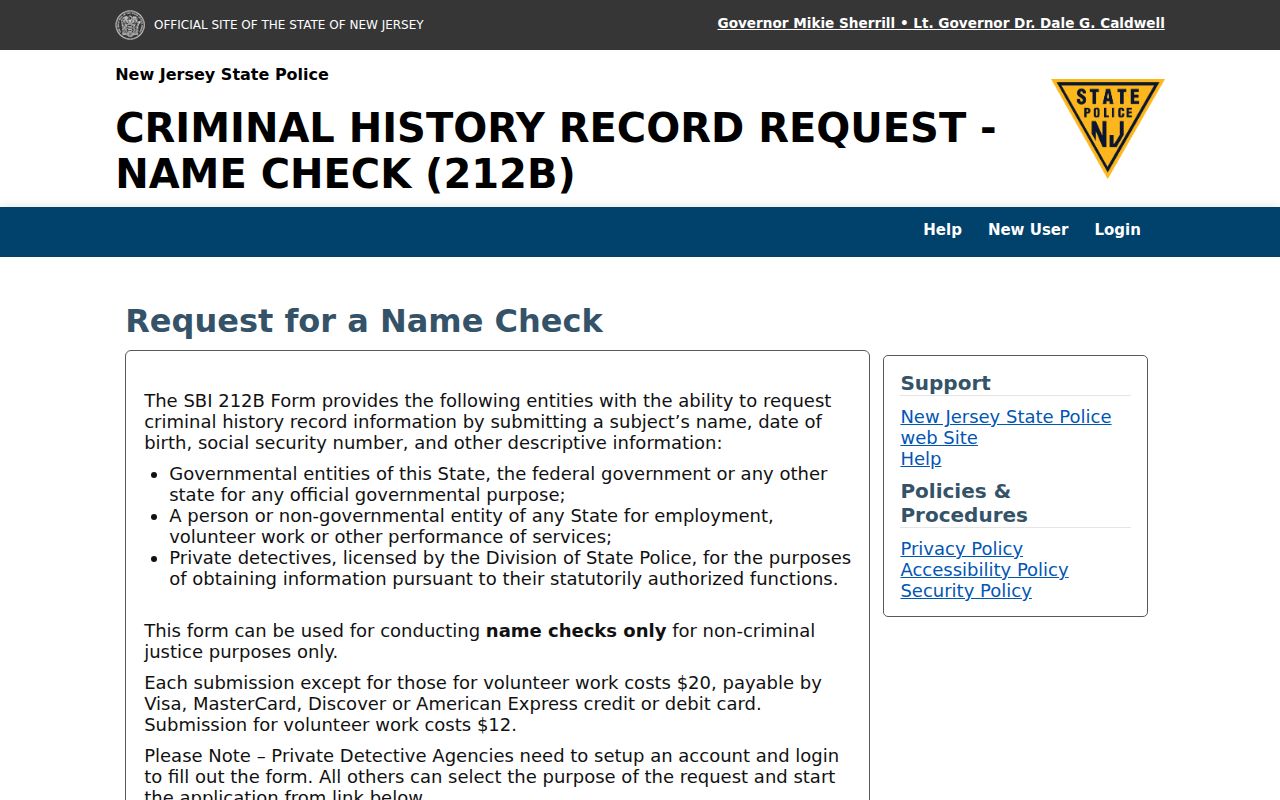
Its controlled request process shows why a 212B search should not be described as a free statewide conviction lookup.
For a personal statewide review, fingerprints give a stronger identity match than a name alone. Program-specific checks can use different service codes and fees, so the agency that requires a check must supply the correct instructions. A Bergen County court search remains separate because the court file can contain hearings, motions, and case events that a repository summary does not display.
Review Your Bergen County Record
A person reviewing their own New Jersey criminal history uses the NJSP Personal Record Request process. The official form sets ORI NJPRR0000, category PRN, reason “PERSONAL RECORD REQUEST,” and document type S1. The form lists a $40.70 payment amount. Bring the completed form and valid, unexpired identification to an appointment with IdentoGO by IDEMIA, then keep the receipt in case follow-up is needed.
IdentoGO's official scheduling channel is shown in the next image.
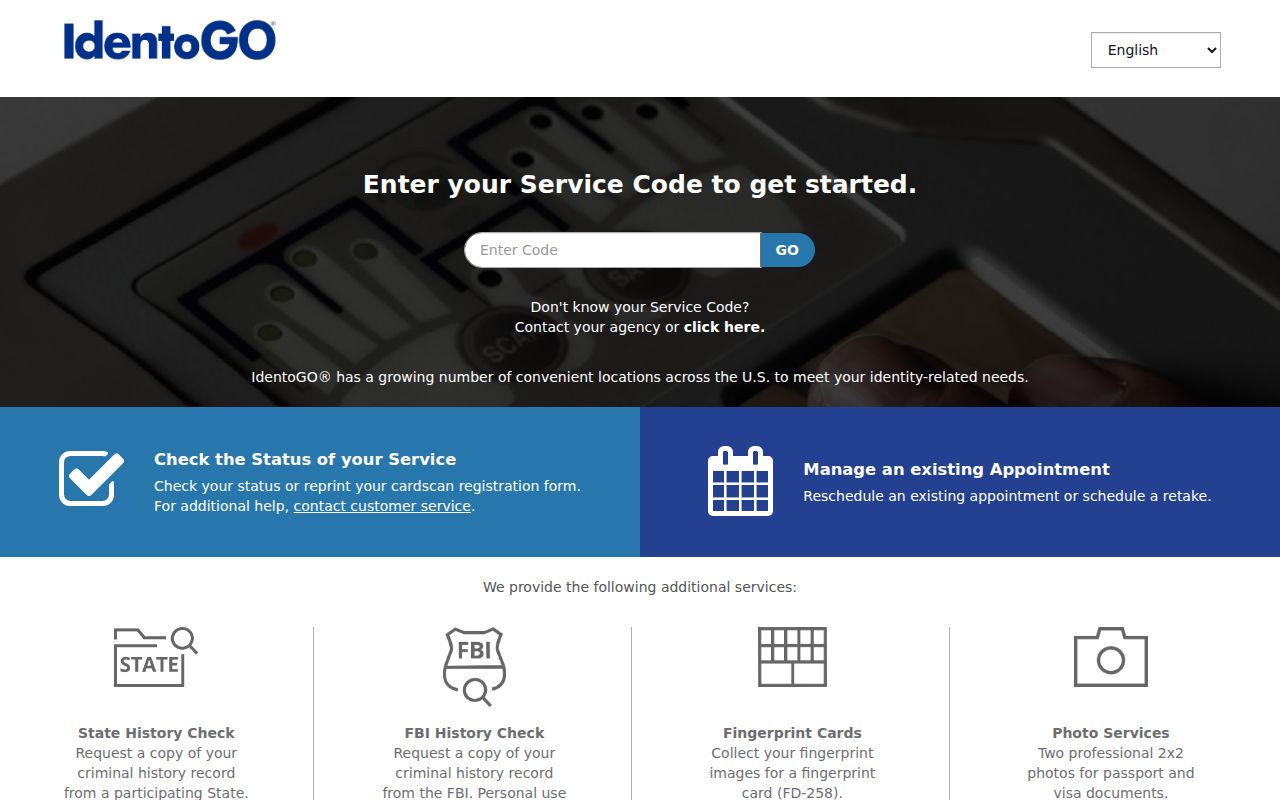
The appointment route ties the request to fingerprints rather than relying only on a similar name and birth date.
If the returned history has a missing or wrong disposition, contact the NJSP Criminal Information Unit at 609-882-2000 ext. 2302 or CIU@njsp.gov. Obtain the final disposition from the court or agency that reported it. Correction differs from expungement: correction fixes inaccurate data, while expungement isolates eligible records under a court process.
Types of Criminal Records
One incident can generate several related records. They should not be read as duplicates. Arrest and booking records describe the taking and processing of a person in custody. Charging documents state allegations. Court files track what judges and parties did, while SBI history groups fingerprint-supported arrest cycles with outcomes reported by prosecutors, courts, and correctional systems.
- Police records: incident reports, arrest facts, and evidence references held by the creating department.
- Booking records: intake, commitment, classification, custody, and release data created at the Bergen County jail.
- Court records: complaints, indictments, appearances, pleas, motions, dispositions, sentences, and financial obligations.
- Repository history: an NJSP identity-based collection of reported arrests and outcomes.
- Supervision and registry records: limited public information from probation, parole, corrections, and Megan's Law channels.
- Indictable crime
- A first-through-fourth-degree offense heard in Superior Court.
- DP or PDP
- A disorderly-persons or petty-disorderly-persons offense heard in municipal court.
- Disposition
- The reported outcome, such as dismissal, acquittal, plea, or conviction.
- SBI number
- The New Jersey State Police identity number tied to fingerprint records.
Juvenile data, victim details, active-investigation material, sealed files, and expunged records may be restricted or absent. Public views also mask personal identifiers that may exist inside agency systems.
Bergen County Criminal Records Room
The principal public counter for an indictable Bergen County case is the Criminal Records Room at the Bergen County Justice Center, 10 Main Street, second floor, Hackensack, NJ 07601. Call 201-527-2700 ext. 2173. This is a key fallback for older records, a file that appears incomplete online, or a question that requires a known docket, indictment, complaint, or case number. Public PROMIS/Gavel terminals at Superior Courthouses are inquiry-only and suppress confidential data.
The official Bergen courthouse history provides the building view shown here.
The working courthouse remains the geographic center for Bergen County criminal case access, not just a historic landmark.
Bergen Criminal Records Room
10 Main Street, 2nd Floor
Hackensack, NJ 07601
201-527-2700 ext. 2173
Bergen County Sheriff
2 Bergen County Plaza
Hackensack, NJ 07601
201-336-3500
Central Municipal Court
71 Hudson Street
Hackensack, NJ 07601
201-336-6222
What a Bergen County Criminal Record Shows
The visible fields depend on the record type. A public court result may identify venue, docket number, caption, initiation date, filed motions, signed orders, and notices. An official PROMIS/Gavel report specification also includes structural fields such as judge, defendant, case number, police case number, indictment number, statute description, disposition, sentence, probation length, restitution, and other financial entries. Not every internal field appears on the free public screen.
| Name and identifiers | Primary name, aliases, birth data, and SBI or case identifiers where public. |
|---|---|
| Arrest and booking | Agency, event date, initial charge, commitment, custody, and release facts. |
| Charges and statutes | Complaint, accusation, indictment, offense description, statute, and degree. |
| Disposition | Dismissal, acquittal, plea, conviction, or another reported outcome. |
| Sentence | Custody, probation, fines, restitution, and other ordered terms. |
| Supervision status | Limited custody, probation, parole, or release information from the proper source. |
Use the docket number as the main cross-reference when asking the Bergen County records room for a document missing from the electronic case jacket.
Bergen County Custody Record Channels
Current county detention is not the same as state imprisonment. The Bergen County Corrections and Rehabilitation Center at 160 South River Street in Hackensack is the reception and processing site for local adult pretrial detention. Its official inmate lookup exists at iml.bcsd.us, but the research inspection found that host unavailable. The sound fallback is to call 201-336-3500 and press #4, inquire at the facility, or submit a specific BCSO request for booking, admission, release, or custody information.
The State Parole Board offender-search page supplied this view of New Jersey custody channels.
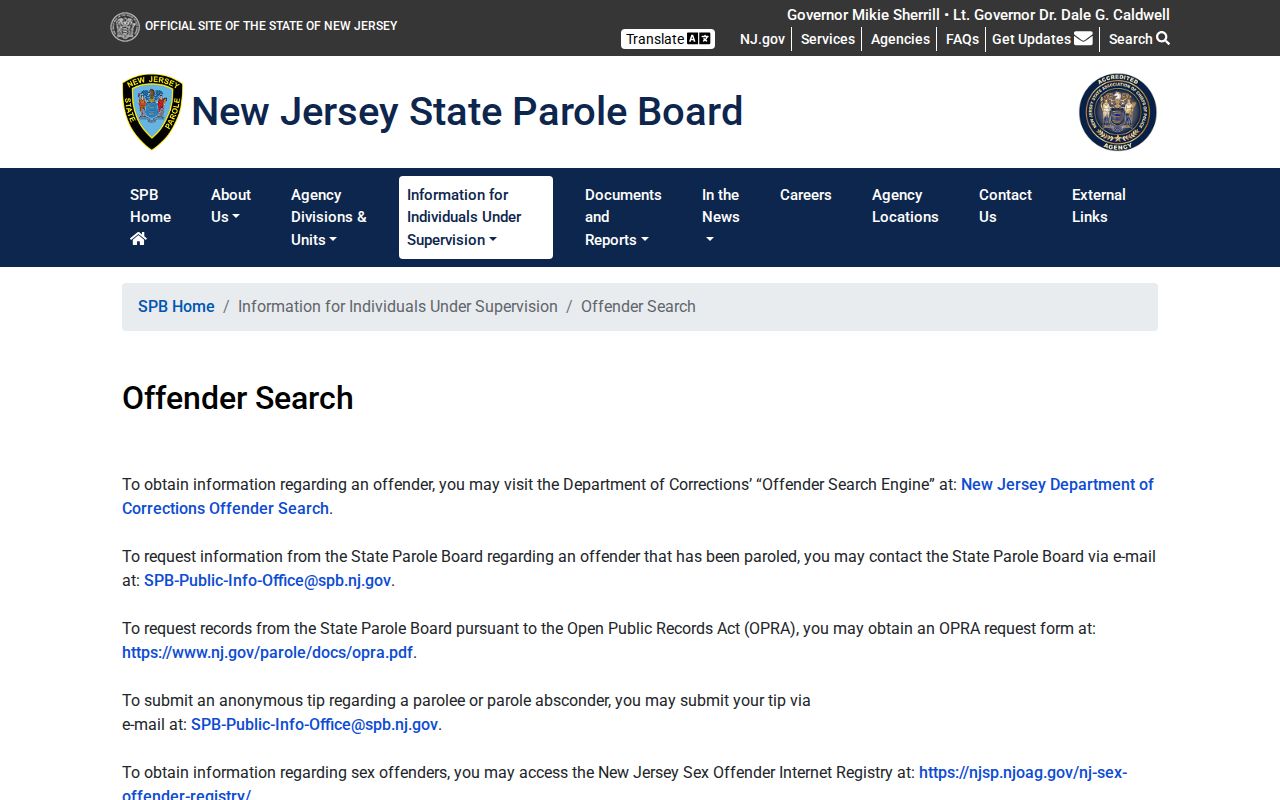
Use NJDOC Offender Search only after transfer to state custody, while parole questions go to the State Parole Board.
Probation is run by New Jersey Courts through Vicinage 2, not by a Bergen County executive department. A public judgment may show that probation was ordered and for how long, but officer notes and supervision files are not a general public lookup. These distinctions prevent a released county detainee from being mistaken for a state prisoner or parolee.
Public Access Laws
New Jersey law separates agency records, court files, criminal-history dissemination, and expungement. OPRA presumes access to government records unless a law or exemption protects them. Court files follow Court Rule 1:38 and Judiciary request procedures. NJSP history products follow their own statutes and rules. The correct law depends on the custodian, not just the subject matter.
Key access rules:
N.J.S.A. 47:1A-1 et seq. sets OPRA access, response, fee, and appeal rules.
N.J.S.A. 47:1A-5 provides the ordinary response framework and standard copy fees.
New Jersey Court Rule 1:38 governs public access and redaction for Judiciary records.
N.J.S.A. 53:1-20.6 et seq. and N.J.A.C. 13:59 structure noncriminal-justice history disclosure.
N.J.S.A. 2C:52-1 et seq. governs expungement and its limits.
Common protected material includes juvenile identifiers, victim records, Social Security numbers, active-investigation detail, sealed documents, and security procedures. A denial under OPRA can be challenged through the Government Records Council or Superior Court.
Bergen County OPRA Record Requests
The Bergen County online OPRA portal accepts county requests around the clock. A requester may also send the county form to the department named on it. Describe a record, not a question. Include the agency, record type, event date, location, report or booking number, and a narrow date range when known. An arrest report created by municipal police must go to that department, while a court file requires the Judiciary process.
The county's official OPRA access page is pictured below.
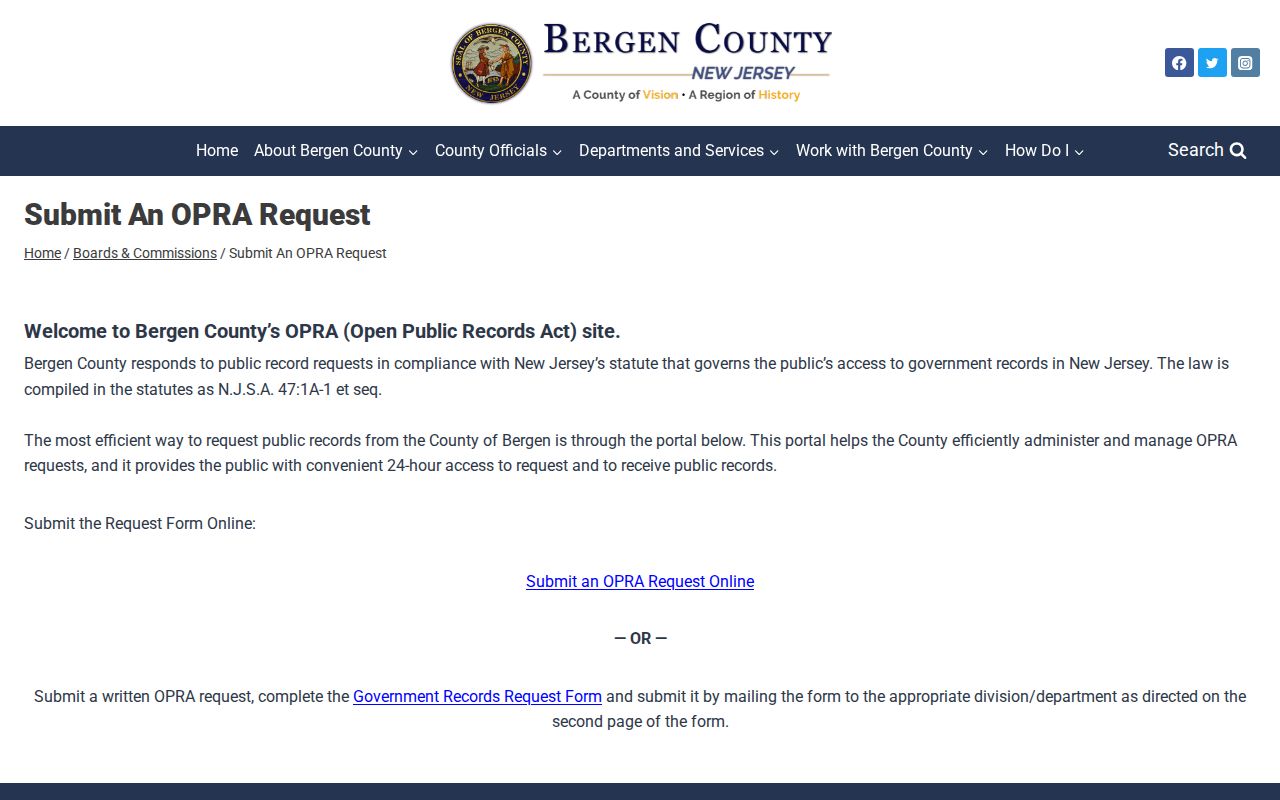
The portal is a fallback for identifiable county records, not a substitute for the court clerk or a municipal police custodian.
| Copy or service | Cost or timing |
|---|---|
| Letter-size page | $0.05 |
| Legal-size or larger page | $0.07 |
| Email or fax | Free unless unusual production costs apply |
| Other medium | Actual production cost |
| Ordinary response | Seven business days |
Extraordinary staff or equipment work can create a disclosed special service charge. A deposit may be requested when reproduction costs exceed $5.
Sealed, Expunged & Restricted
An expungement isolates eligible New Jersey records from routine public access. It does not rewrite the historic event, and statutes preserve access for defined purposes. The Judiciary's electronic process covers traditional petitions, clean-slate expungement under N.J.S.A. 2C:52-5.3, and qualifying marijuana or hashish relief. Eligibility and waiting periods vary, so current court instructions and Title 2C should control.
The New Jersey Courts expungement resource is the source for the process shown here.
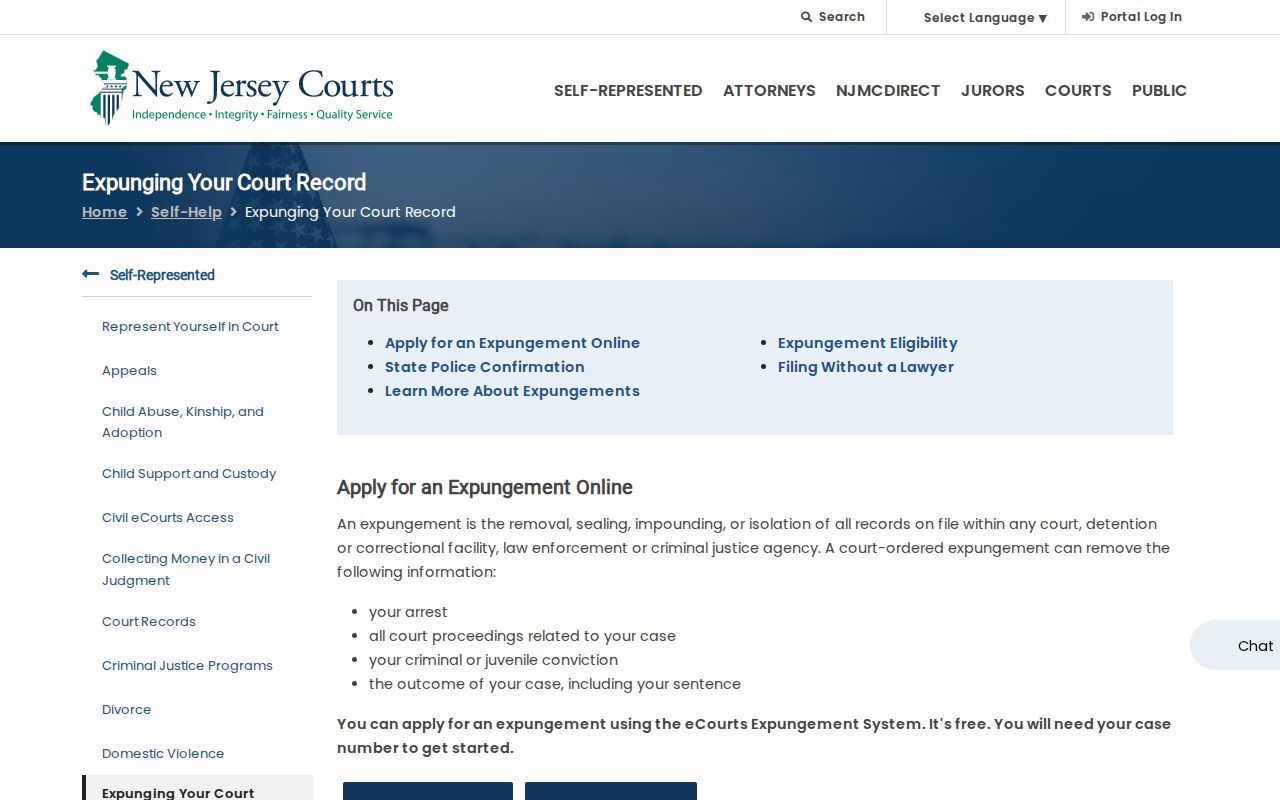
The electronic filing route helps a petitioner locate and list the Bergen County arrests, complaints, courts, and agencies tied to the petition.
Restriction also reaches juvenile and family material, victim identifiers, sealed matters, and active investigations. A missing record may therefore be lawfully withheld. If the problem is a wrong outcome or incomplete arrest cycle, use the NJSP challenge route and obtain proof from the reporting court instead of filing an expungement merely to correct data.
Bergen County Criminal Diversion Paths
Bergen County Prosecutor's Office is the county charging authority, not a district attorney. It screens indictable complaints referred from municipal courts, addresses detention motions and Early Disposition Court, and decides which cases move toward grand jury. Its programs can also change the path a case takes. Pretrial Intervention involves screening and prosecutorial review, while the Veterans Diversion Program uses eligibility review and six-month judicial reviews. The Bergen County Prosecutor's Office is shown in the official source image below.

The prosecutor's role explains why an initial municipal complaint may later be screened, changed, diverted, dismissed, or presented for indictment.
The county's Central Municipal Diversion Program grew from a Fair Lawn pilot into a countywide route in early 2023 for qualifying addiction-related possession, shoplifting, and other municipal matters. BCPO's diversion program description supplied the next image.
Diversion can affect the final record, but the filed complaint and later disposition must still be read from the proper court source.
Criminal Records by City in Bergen County
City-level searches begin with the municipality that made the report or issued the complaint. Hackensack, Fort Lee, and Fair Lawn each has its own police records channel and municipal court. County jail and Superior Court systems become relevant only when custody or an indictable charge moves beyond the local office. These city guides keep that local routing clear.
Hackensack Criminal History
46,380 estimated residents · Police records and Municipal Court Code 0223.
Fort Lee Criminal History
40,191 residents in 2020 · Borough police and municipal court channels.
Fair Lawn Criminal History
37,128 estimated residents · Police Records Bureau and borough court access.
When a city report leads to county detention or an indictable prosecution, use its complaint or report number to bridge the local file to Bergen County records.
Bergen County Criminal Justice History
Bergen became a judicial district in 1675 and one of New Jersey's original counties in 1683. Hackensack became the county seat in 1710. A combined courthouse and jail stood on the historic Green by 1716, while a later courthouse was burned by British and Hessian forces in 1780. Court and jail work moved for a time to Oakland before returning to Hackensack.
The current courthouse was designed by James Riely Gordon in a Beaux-Arts style with Roman and Italian Renaissance references. Its cornerstone was laid in 1910, and construction was complete in 1912. Today the Justice Center, county administration, Prosecutor's Office, Sheriff, jail, and Central Municipal Court form a compact records district around Hackensack. That long history helps explain why Bergen County criminal records remain divided among court, law-enforcement, detention, and administrative custodians rather than stored in one local archive.
The NJSP repository overview shows the modern statewide layer that connects fingerprints, court outcomes, and corrections information.
The statewide repository links reports from many agencies, but the original Bergen County files remain with the offices that made them.